
Beyond the Basics: 5 Study Habits Every Grade 4 Student Needs to Master
For many parents, Grade 4 feels like a sudden "gear shift." In the foundation phase (Grades 1–3), the focus was on the basics: phonics, simple addition, and a lot of teacher-guided activity.
But as your child enters Grade 4, the workload changes. Suddenly, there are "content subjects" like Social Sciences and Natural Science. Textbooks get thicker, and for the first time, students are expected to study independently for tests and exams.
Helping your child bridge this gap is about more than just working harder—it’s about working smarter. Here are five study habits your Grade 4 student needs to master to thrive in the intermediate phase.
1. Moving from "Reading" to "Summarizing"
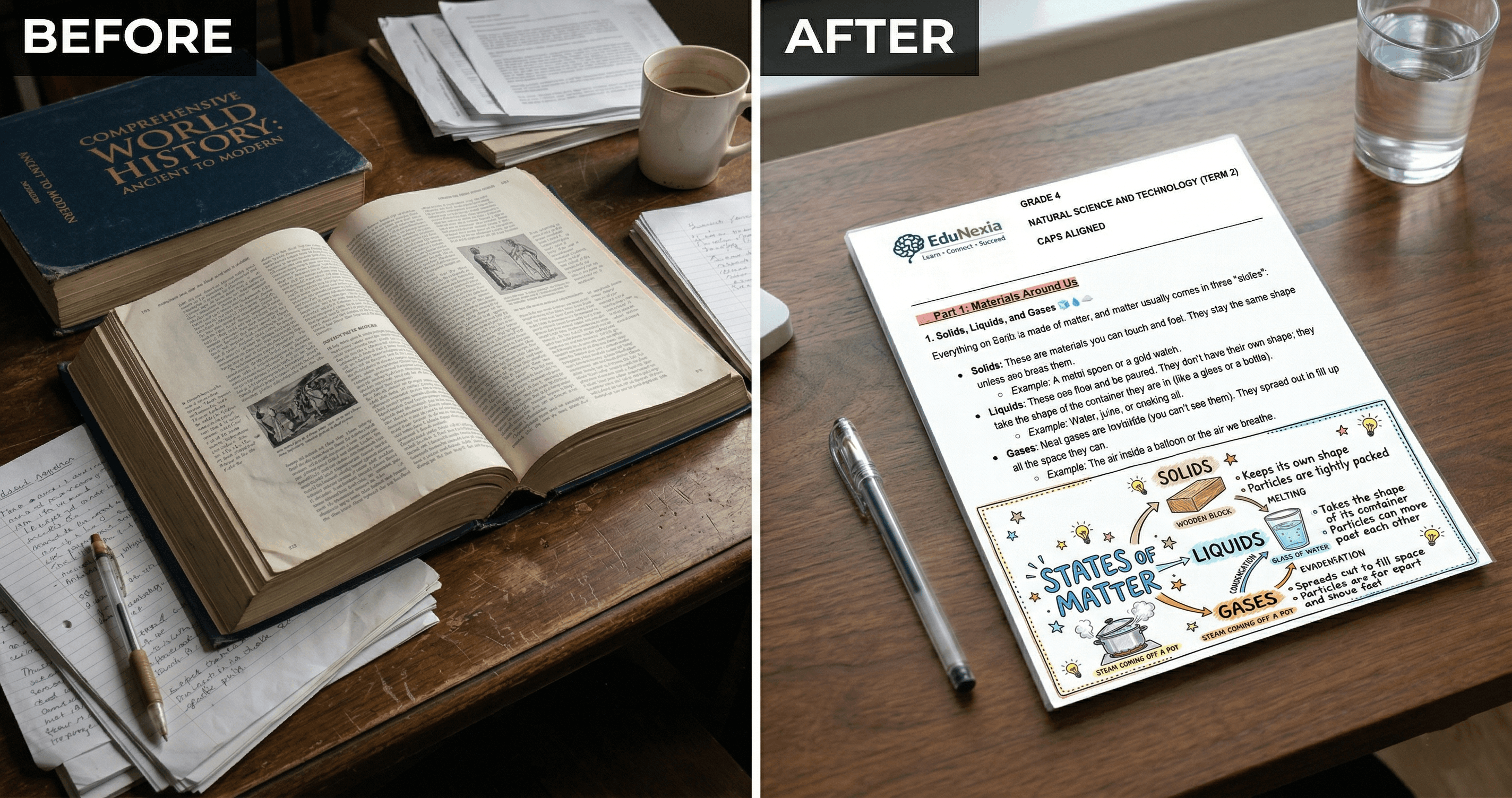
In earlier grades, a child might read a page and simply try to remember it. In Grade 4, the volume of information is too high for pure memorization. Students need to learn how to identify the "Main Idea."
The Habit: Encourage your child to read a paragraph and then tell you, in just one sentence, what it was about.
-
How we help: Our Grade 4 PDF Summaries take the guesswork out of this. We’ve already distilled those heavy textbook chapters into easy-to-digest bullet points, helping your child see exactly what information is most important.
2. The Power of "Active Recall"
Most students think that reading a page three times counts as studying. Unfortunately, that’s "passive learning." To really make information stick, the brain needs to be challenged.
The Habit: Use the "Cover and Speak" method. After studying a section of their notes, have your child cover the page and try to explain the concept to you (or even to their stuffed animals!) out loud. If they can teach it, they’ve mastered it.
3. Breaking "Big Subjects" into Bite-Sized Chunks
In Grade 4, subjects like History and Geography can feel overwhelming because of the amount of content. If a child looks at a 20-page chapter, they often shut down.
The Habit: Teach your child to "chunk" their work. Instead of saying "We are studying Science today," say "Today, we are only looking at the life cycle of a flowering plant." Smaller goals lead to small wins, which build confidence.
4. Establishing a "Study Sanctuary"
Focus is a muscle that needs the right environment to grow. Grade 4 is the year to move away from studying on the couch or in front of the TV.
The Habit: Create a dedicated study space that is stocked with the essentials (pencils, rulers, and their printed PDF summaries). Keep this area "tech-free" unless they are using a tablet specifically for their notes. A consistent environment signals to the brain that it’s time to work.
5. Managing a Weekly Study Calendar
In the lower grades, homework was usually "due tomorrow." In Grade 4, students might have a project due in two weeks or a test next Friday.
The Habit: Introduce a simple weekly planner. Every Sunday, sit down and look at the week ahead. Visualizing their week helps children feel in control and reduces the "night-before-the-test" panic that many families experience.
The Secret to a Stress-Free Grade 4 Year
The transition to the intermediate phase is a big jump for children—and parents! The biggest hurdle is often the sheer volume of new vocabulary and facts.
Our mission is to make that jump feel like a small step. Our Grade 4 Study Summaries are designed specifically to follow the curriculum, breaking down complex textbook chapters into colorful, easy-to-understand PDFs. They save you time and give your child the confidence they need to succeed.