
From Overwhelmed to Organized: Why Summaries are the Secret Weapon for Grades 4 to 7
If you have a child in Grade 4, 5, 6, or 7, you’ve likely felt the "Intermediate Phase Shift." It’s that moment when the school bag gets heavier, the textbooks get thicker, and the "simple" homework suddenly involves complex terms in Social Sciences, Natural Sciences, and Life Skills.
For many learners, the jump from Grade 3 to Grade 4 (and later into Grade 7) is a shock. They go from learning to read to reading to learn. But what happens when the volume of information is just too much to digest?
That is where the power of high-quality summaries comes in. Here is why summarizing is the most critical skill for this age group—and how our store helps you bridge the gap.
1. Beating the "Wall of Text" Anxiety
When a 10-year-old opens a 20-page chapter on "History of Transport" or "Photosynthesis," they often don’t know where to start. This leads to procrastination and "study paralysis."
-
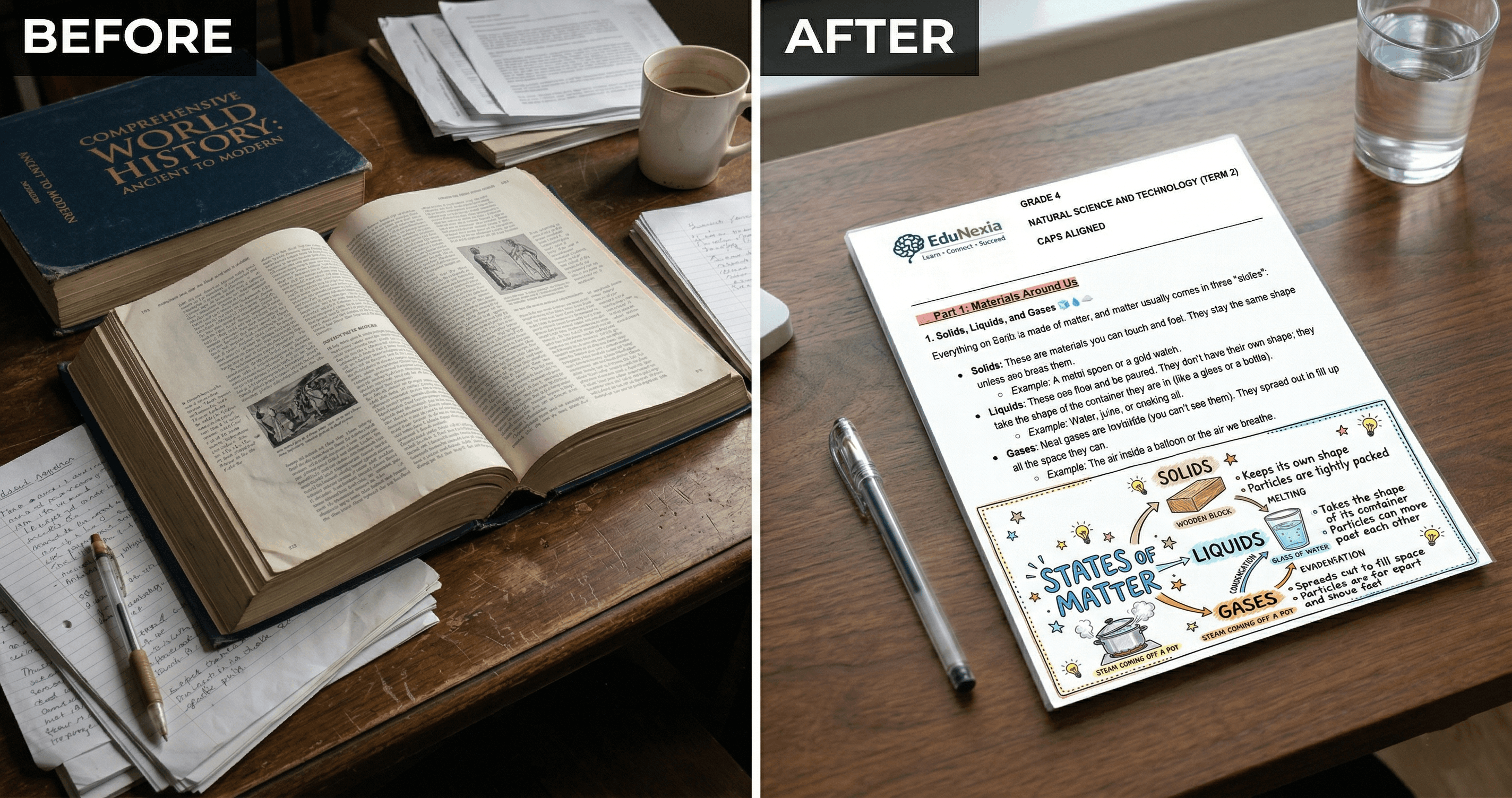
How Summaries Help: By breaking down heavy chapters into bite-sized, bulleted points, we remove the "fear factor." It’s much easier for a child to commit to studying three pages of clear summaries than a 50-page textbook.
2. Transitioning from "Rote Learning" to Understanding
In the junior grades, kids can often get by on memory. From Grade 4 onwards, they are tested on application.
-
The Problem: If a child spends all their energy just trying to read the textbook, they have no brainpower left to understand the concepts.
-
The Solution: Our summaries highlight core concepts and keywords. This allows your learner to spend less time "reading" and more time "explaining" the work back to you—the key to long-term retention.
3. Reclaiming Your Family Time
Let’s be honest: Parents often spend their evenings becoming "unpaid tutors." Making your own summaries after a long day at work is exhausting for both you and your child.
-
The Value of Prepared Notes: By using our professionally curated Grade 4–7 summaries, you skip the hours of highlighting and scribbling. You can go straight to the "quiz phase," making study sessions faster, more effective, and much less stressful.
4. Teaching "How" to Study
Grade 4–7 is the training ground for High School. If a learner doesn’t learn how to filter important information now, they will struggle later.
-
Study Tip: Use our summaries as a roadmap. Have your child compare the summary to their textbook. It teaches them how to identify main ideas—a skill that will carry them all the way to University.
How to Use Our Summaries Effectively:
-
The "First Look": Have your child read the summary before the teacher covers the topic in class. It builds confidence.
-
Color Coding: Encourage your learner to use highlighters on our printed summaries to personalize them.
-
Active Recall: Cover a section of the summary and ask your child to explain it in their own words.
Ready to simplify exam season?
We’ve done the hard work so your child doesn't have to. Our Grade 4 through 7 summaries are aligned with the curriculum and designed to be visually engaging and easy to understand.
Stop the study-time struggle and start seeing the results your child is capable of!